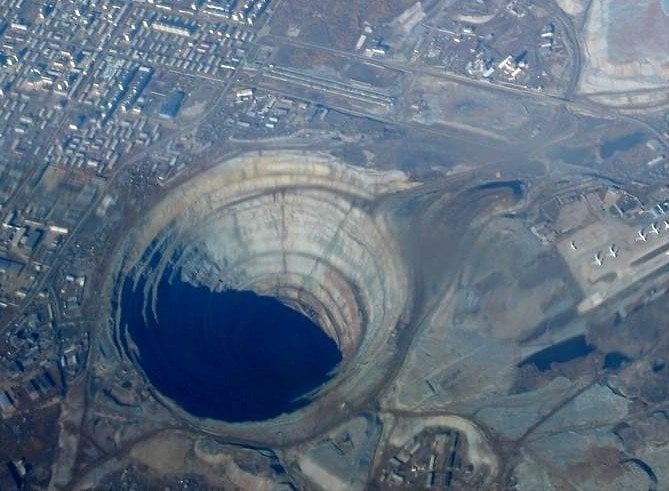
In 1970, a group of Soviet scientists began what would become one of the most ambitious — and unsettling — scientific experiments in human history. On a remote stretch of the Kola Peninsula in Russia, they set out to dig the deepest hole ever made by man.
The goal? To study the Earth’s crust and understand what lies beneath our feet. What they didn’t expect, however, was that the journey downward would uncover things that would baffle even the most brilliant geologists.
After 19 years of drilling, they finally reached a staggering 12.2 kilometers (7.6 miles) deep — so deep that if you dropped a stone, it would take over 40 seconds to hit the bottom. This became known as the Kola Superdeep Borehole, and to this day, it remains the deepest artificial hole on Earth.
At that depth, temperatures reached an unbelievable 180°C (356°F) — much hotter than scientists predicted. The intense heat made it impossible to drill further. But the real shock came when they analyzed the rock samples.
They found tiny fossilized plankton, microscopic remnants of life — buried in solid rock that was estimated to be over two billion years old. No one expected to find evidence of ancient life at such unimaginable depths.
When the project was eventually sealed in the early 1990s, rumors began to spread across the world. A bizarre story surfaced, claiming that when scientists lowered a microphone into the borehole, they recorded “screams from hell.” Newspapers, radio shows, and early internet forums spread the tale like wildfire.
But the truth is far less supernatural — and yet, still just as haunting.
The sounds were simply rock movements and echoing vibrations, distorted and amplified by depth and heat. But combined with the eerie desolation of the site, the rumor became one of the most famous science-based legends ever told.
Today, the Kola Superdeep Borehole is sealed shut, welded with a metal cap. Locals call it “the entrance to hell,” while scientists see it as a reminder of just how little we truly know about the Earth beneath us.
What started as a quest for knowledge became a symbol of humanity’s endless curiosity — and our unsettling realization that some mysteries are better left buried.