Neutron stars are among the most extreme and fascinating objects ever discovered in the universe. Formed in the aftermath of a colossal supernova explosion, they pack more mass than the Sun into a sphere no larger than a city. Even though they are tiny by cosmic standards, the physics inside them is so intense and so strange that scientists still struggle to fully understand what goes on beneath their surfaces. Inside a neutron star, atoms collapse, forces reach unimaginable strengths, matter changes form, and quantum laws dominate every layer. This extended guide takes you deeper into the hidden interior of a neutron star, exploring its origin, structure, mysteries, and the unimaginable processes that occur within it.
What A Neutron Star Really Is
A neutron star begins its existence during the violent death of a massive star. When such a star uses up all its nuclear fuel, it can no longer resist the inward pull of gravity. In less than a second, the core collapses. Protons and electrons are crushed together to form neutrons. The collapse stops only when the neutrons themselves resist being squeezed further. The outer layers of the star are blasted into space as a supernova. What is left behind is a compact object made almost entirely of neutrons. Although it is small, it contains more mass than the Sun, making it one of the densest objects in the universe.
The Unimaginable Density Of Neutron Star Matter
To understand how strange neutron star matter is, imagine taking Mount Everest and compressing it into the size of a marble. Now imagine filling a football stadium with marbles like that. The density of a neutron star is so great that one teaspoon of its material would weigh billions of tons. The pressure is so extreme that normal atomic structure collapses. Electrons are forced into protons, forming neutrons. This process produces a world dominated by nuclear physics, quantum mechanics, and forces that have no comparison on Earth. Every cubic centimeter inside this star is a battlefield where matter is pushed to its ultimate limits.
The Extreme Gravity That Shapes The Star
Gravity on the surface of a neutron star is overwhelming. Everything is crushed downward. If you dropped an object from a height of just one meter, it could hit the surface at nearly half the speed of light. A human standing on the surface would be flattened instantly. This gravity also distorts the flow of time. Time passes more slowly on a neutron star than on Earth. Light trying to escape loses energy because gravity is so strong it drags space itself inward. Even the shape of the star is influenced by this gravity. A rotating neutron star becomes slightly flattened because its immense rotation tries to stretch it outward, while gravity tries to pull it back inward.
The Outer Crust Where Matter Begins To Break Down
The outer crust of a neutron star is a region where matter still resembles normal atoms, but only at the very surface. These atoms are squeezed together into crystal-like structures that are extremely dense. As you move deeper into the crust, the pressure becomes so intense that electrons are forced into atomic nuclei. This process destroys the familiar structure of atoms. What remains are exotic nuclei packed tightly into a grid surrounded by a sea of electrons. This crust is enormously strong, possibly billions of times stronger than steel. It acts as a rigid shell that holds the star together.
The Inner Crust Where Nuclear Pasta Forms
Going deeper, the crust transitions into one of the most unusual states of matter known to science. Here, the pressure forces atomic nuclei to stretch and melt into strange shapes that scientists call nuclear pasta. These shapes include long rods, flat sheets, twisted coils, and structures that resemble complex biological forms. They form because the forces between neutrons and protons compete under extreme pressure. Nuclear pasta might be the strongest material in the universe. It affects how heat travels through the star and influences how the star emits radiation. This layer is both beautiful and bizarre, a natural laboratory where extreme forces sculpt matter into exotic patterns.
The Neutron Superfluid Beneath The Crust
Below the crust lies an ocean of free neutrons that behave unlike anything we know on Earth. These neutrons enter a special quantum state called a superfluid. A superfluid has no friction. It can flow endlessly without losing energy. It can drip through cracks, rotate in perfect vortices, and behave like a single giant quantum entity. Inside a neutron star, the superfluid forms giant swirling structures that rotate with the star. Sometimes these vortices suddenly shift or break free from the crust. When this happens, the star’s rotation suddenly changes in an event called a glitch. Glitches send signals across space, revealing the strange internal dynamics of the star.
The Outer Core Where Matter Becomes Even Stranger
Beneath the superfluid ocean lies the outer core. Here, the pressure is even greater. The neutrons are packed so tightly that additional particles may begin to appear. Protons, electrons, and muons mix with neutrons in a dense, particle-rich soup. The forces at play are intense. At this depth, the strong nuclear force competes with gravity in ways scientists do not fully understand. Temperatures may reach hundreds of millions of degrees, yet the matter remains in a densely packed quantum state. This region plays a key role in how heat moves through the star and how magnetic fields are sustained.
The Inner Core Where Matter Reaches New Forms
The inner core of a neutron star is one of the greatest mysteries in astrophysics. No one knows for sure what matter becomes at this depth. Several theories exist. One possibility is that neutrons break apart into quarks, creating a quark-gluon plasma similar to the state of the early universe moments after the Big Bang. Another idea is that exotic particles known as hyperons appear. These particles contain strange quarks and are heavier than normal nucleons. Some theories propose even stranger possibilities such as color superconductors, where quarks pair up and move in coordinated ways through the core. This region may hold the key to understanding the fundamental forces that shape matter.
The Magnetic Fields That Control The Star
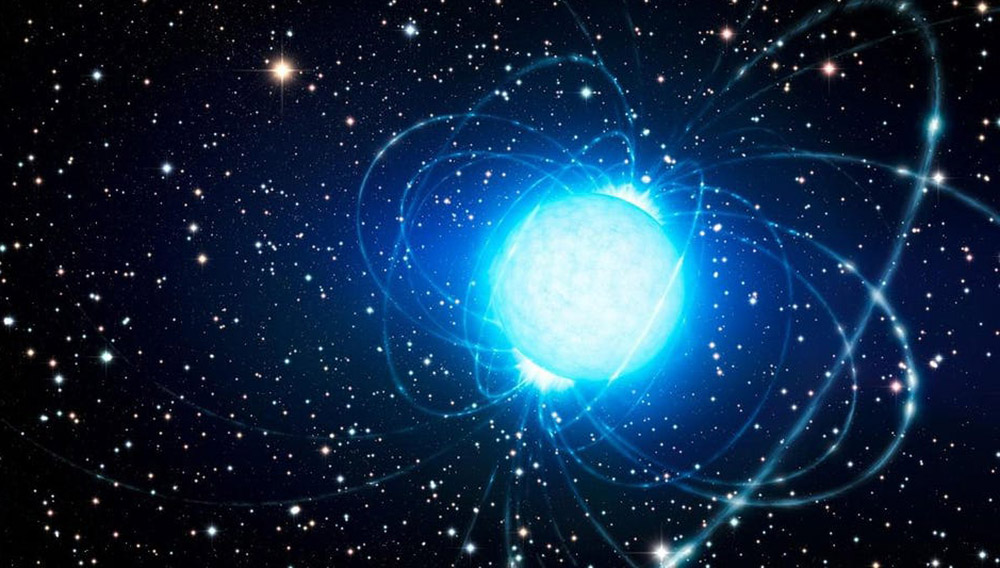
Neutron stars possess magnetic fields far stronger than anything humans can create. Some neutron stars, known as magnetars, have magnetic fields trillions of times stronger than Earth’s. These fields twist and stretch the star’s crust. They can cause enormous bursts of radiation when they snap. The magnetic field can influence how matter behaves, how particles move, and how light travels. Even empty space behaves differently near the star. Photons can split or merge, and space can become polarized. These extreme magnetic effects make magnetars some of the most unpredictable objects in the universe.
Why Neutron Stars Shine Without Fusion
Unlike regular stars, neutron stars no longer fuse hydrogen or helium. Their glow comes from other sources. Many neutron stars emit beams of radiation from their magnetic poles. These beams sweep across space as the star rotates, creating pulses of light we detect as pulsars. Some pulsars spin hundreds of times per second. Their timing is so precise they can be used to detect gravitational waves or measure small variations in space. A neutron star can shine through magnetic activity, rotation, heat left over from its formation, or particle acceleration near its surface.
Starquakes And Violent Internal Changes
Neutron stars undergo massive internal stresses. The crust is strong, but the forces acting on it are overwhelming. As the star cools or rotates, stresses build up. When the crust can no longer handle the pressure, it cracks in a violent starquake. These starquakes release immense energy. In magnetars, starquakes can produce bursts of gamma rays powerful enough to be detected across the galaxy. These events give scientists clues about the internal structure of the star and the behavior of its magnetic field.
How Neutron Stars Help Us Understand The Universe
Neutron stars are cosmic laboratories. They help scientists study physics under conditions impossible to recreate on Earth. By observing neutron stars, researchers test theories about gravity, quantum mechanics, and nuclear physics. Every pulse, glitch, burst, or starquake provides new data. These stars help us understand the behavior of matter at densities beyond nuclear levels. They also help map gravitational waves, explore the early universe, and understand the life cycle of stars.
The Deepest Mystery At The Center
The most puzzling part of a neutron star remains its core. Scientists do not know whether matter there becomes quark soup, hyperon matter, or something entirely different. This region remains beyond all experimental reach. Future telescopes, gravitational wave detectors, and theoretical models may finally reveal the truth. Until then, neutron stars remain one of the greatest cosmic wonders, filled with mysteries waiting to be uncovered.