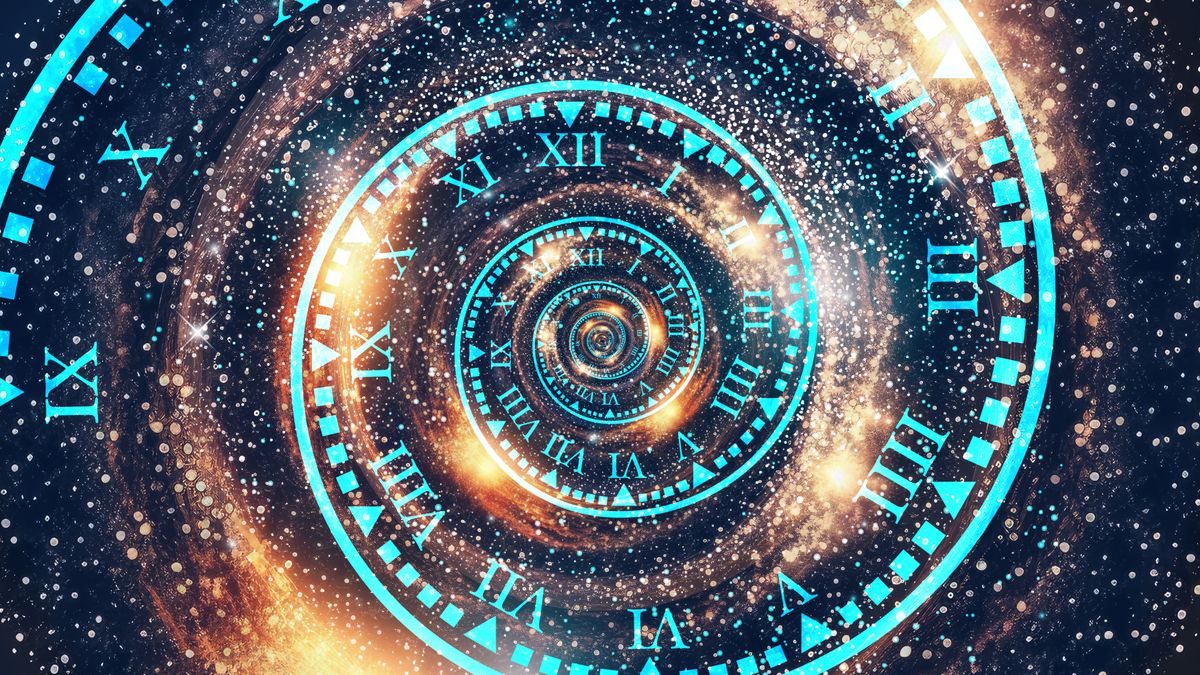
Time is one of the most fundamental aspects of human existence, yet it remains one of the greatest mysteries in science. We live our lives according to time, measure our days with clocks, and remember our past through time-stamped experiences. But what exactly is time? Why does it move forward and never backward? Does it flow at a constant rate, or can it change under certain conditions? Modern physics has uncovered surprising truths about the nature of time—revealing that it is not as simple or fixed as our daily experience suggests. Understanding the physics of time opens the door to profound insights about the universe, from the behavior of particles to the fate of galaxies. It is a journey into a realm where intuition often fails, but knowledge illuminates hidden truths.
What Is Time? Scientific and Philosophical Perspectives
Time has puzzled thinkers for centuries. Philosophers such as Aristotle and Augustine asked whether time exists independently or only in the human mind. In modern physics, time is defined as a dimension, similar to space, in which events occur in sequence. It is woven into the fabric of the universe, forming what physicists call spacetime. Instead of being a standalone flowing entity, time is interconnected with space, matter, and energy. This means that time is influenced by physical conditions, and its behavior changes depending on motion and gravity. While everyday experience frames time as linear and steady, the scientific view reveals a more dynamic and flexible structure that can stretch, bend, or even nearly stop under extreme circumstances.
Einstein’s Relativity: When Time Stops Being Absolute
Albert Einstein revolutionized the understanding of time with his theories of relativity. According to special relativity, time is relative, not absolute. It passes at different rates depending on an object’s speed. The faster you move, the slower time flows for you compared to someone at rest. This phenomenon, known as time dilation, has been confirmed by countless experiments. General relativity extends this idea by showing that gravity also affects time. Massive objects warp spacetime, causing time to slow down in stronger gravitational fields. This means clocks run slower near massive bodies such as planets, stars, and black holes. Relativity shattered the old notion of universal time and revealed a universe where time is elastic, shaped by motion and mass.
Time Dilation: When Time Moves at Different Speeds
Time dilation is one of the most fascinating consequences of relativity. It means that two people moving at different speeds or located in different gravitational environments experience time differently. For example, astronauts aboard the International Space Station age slightly slower than people on Earth because their orbit gives them both higher speed and slightly weaker gravity. Experiments with atomic clocks on airplanes, satellites, and spacecraft have repeatedly verified this effect. In extreme scenarios such as near a black hole, time dilation becomes dramatic. A person orbiting close to a black hole could experience hours while years pass elsewhere in the universe. This idea, once purely theoretical, is now widely accepted and used in technologies like GPS, which must correct for time dilation to remain accurate.
The Arrow of Time: Why Time Moves Forward
One of the deepest questions in physics is why time flows in a single direction. While the laws of physics allow processes to run forward or backward, our experience shows time always moving from past to future. This phenomenon is known as the arrow of time. The most widely accepted explanation comes from the second law of thermodynamics, which states that entropy—disorder in a system—always increases over time. A broken glass does not reassemble, and smoke does not return to a cigarette because these processes decrease entropy. The universe began in a low-entropy state, and its natural progression toward higher entropy creates the arrow of time. Understanding entropy not only explains why time moves forward but also reveals deep connections between physics, cosmology, and the evolution of the universe.
Time and the Brain: How Humans Perceive Time
Human perception of time is shaped by biology, psychology, and environment. The brain does not have a single “time organ,” but instead relies on multiple neural circuits to track duration, sequence, and rhythm. Emotions strongly influence time perception—frightening or exciting events seem to last longer due to heightened awareness, while routine moments pass quickly because the brain stores fewer unique details. Age also affects time perception, with days feeling longer in childhood and shorter in adulthood. Research shows that attention, memory, and dopamine levels all play roles in shaping how we experience time. This means that subjective time is flexible and personal, unlike physical time governed by cosmic rules.
Experiments That Reveal the Strange Nature of Time
Throughout the last century, scientists have conducted groundbreaking experiments that expose the unusual behavior of time. The Hafele–Keating experiment flew atomic clocks on airplanes, showing measurable differences from clocks on the ground. Particle accelerators reveal time dilation daily when unstable particles traveling near light speed survive far longer than expected. Observations near black holes, such as those made by the Event Horizon Telescope, demonstrate gravitational time dilation on astronomical scales. Quantum experiments add even more mystery. In quantum entanglement, linked particles influence each other instantly, raising questions about whether time behaves differently at the microscopic level. These experiments expand scientific understanding and challenge preconceived notions of time’s limitations.
Can Time Travel Ever Be Possible?
Time travel is a topic that captures imagination, appearing in films, literature, and scientific debates. According to relativity, traveling forward in time is not only possible but already happening in small amounts due to natural time dilation. Traveling far into the future would simply require reaching speeds close to the speed of light or approaching a massive gravitational source. Traveling to the past is more controversial. Some theoretical models, such as wormholes or rotating universes, suggest that backward time travel might be mathematically possible. However, these scenarios involve extreme conditions or hypothetical materials with exotic properties that have never been observed. Additionally, paradoxes such as the grandfather paradox raise logical challenges. While time travel remains speculative, scientific exploration continues to uncover new possibilities.
The Future of Time Research: What Scientists Still Don’t Know
Despite major breakthroughs, many mysteries about time remain unsolved. Scientists do not fully understand why the universe began with low entropy or how quantum mechanics and relativity unify in a single theory of spacetime. The relationship between time and consciousness is still unclear, and questions persist about whether time is a fundamental feature of reality or a human-created concept emerging from deeper physical laws. Researchers are exploring ideas such as emergent time, where time arises from quantum entanglement patterns, and theories that suggest time may not exist at the most fundamental level. As science advances, new discoveries may transform our understanding of reality and reveal that time is far stranger than we can imagine.
Conclusion: Time as the Key to Understanding the Universe
Time governs every aspect of existence, from the motion of galaxies to the rhythm of human life. Its complexities challenge intuition yet inspire some of the most profound scientific investigations. By studying time through physics, neuroscience, and cosmology, scientists uncover the principles shaping reality itself. Time is not a simple, steady flow but a dynamic dimension influenced by gravity, speed, entropy, and perception. As research continues, the mysteries of time will bring humanity closer to understanding the true nature of the universe and our place within it. The physics of time remains a gateway to deeper knowledge, innovation, and endless wonder.