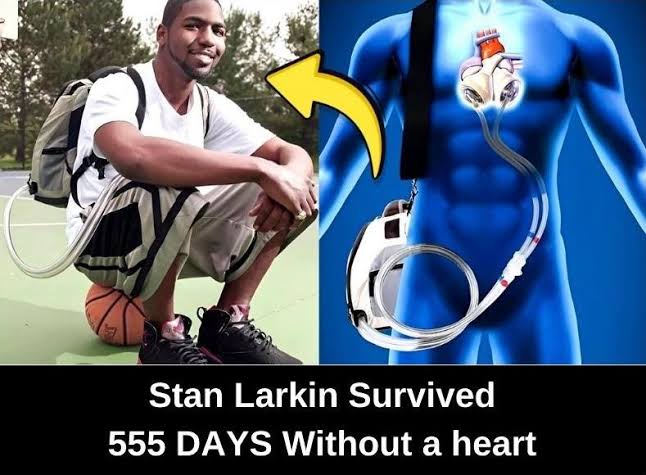
Stan Larkin made medical history by surviving for 555 days without a natural heart relying entirely on a total artificial heart to sustain his life. His story is one of the most remarkable examples of medical innovation and human resilience. In the early 1990s Larkin suffered from end stage heart failure a condition in which the heart can no longer pump enough blood to meet the body’s needs. Traditional treatments were no longer sufficient and doctors determined that the only option to save him was a total artificial heart a mechanical device that completely replaces the human heart and pumps blood throughout the body.
The surgical procedure to implant the total artificial heart was complex and high risk. Larkin’s failing natural heart was removed and replaced with a mechanical device that functioned as both ventricles. Unlike other devices that support only a part of the heart a total artificial heart completely substitutes the natural organ. The device required connections to external power sources and monitoring equipment to ensure proper operation. Despite the dangers Larkin agreed to undergo the procedure understanding that it was his only chance for survival.
After the surgery Larkin was closely monitored by medical staff who tracked his vital signs ensured the artificial heart was functioning correctly and managed any potential complications. Remarkably he adapted to the device and was able to regain some mobility and independence. He could interact with his family and engage in activities while remaining under careful supervision. His survival for over a year and a half made him one of the longest living patients entirely dependent on a total artificial heart while awaiting a transplant and drew attention from the medical community worldwide.
Living without a natural heart required Larkin to adhere to strict medical routines. He had to rely on external power sources for the artificial heart and attend frequent checkups to monitor his health. Despite these limitations he maintained his daily life demonstrating that a meaningful existence is possible even under extraordinary circumstances. His story offered hope for patients with severe heart conditions and highlighted the life saving potential of total artificial heart technology.
Larkin’s case also sparked conversations about the ethical and practical implications of life sustaining devices. Doctors debated the costs risks and long term consequences of keeping patients alive with mechanical hearts. While challenges were significant his survival proved that with careful planning advanced technology and dedicated medical care life could be extended in ways previously unimaginable. His experience became a reference point in the study and development of artificial heart technology and treatment of end stage heart disease.
Media coverage of Larkin’s story brought it to the attention of the public worldwide. News articles documentaries and interviews highlighted the technical achievement the bravery of Larkin and the dedication of the medical team. The story captivated people because it challenged fundamental assumptions about survival and demonstrated how far modern medicine had advanced. It also sparked interest in the possibilities of future medical innovations and the resilience of the human body.
Medical experts emphasized that Larkin’s survival was the result of decades of research in cardiovascular medicine. The total artificial heart he received represented the cutting edge of medical science combining engineering innovation and clinical expertise. His case showed that with ingenuity determination and careful monitoring patients could survive conditions once thought impossible. For those suffering from severe heart failure Larkin’s story became a source of hope and inspiration.
The case also influenced future developments in artificial organs. Scientists and engineers continue to refine devices to improve durability reduce dependency on external power and enhance patient mobility. Larkin’s experience served as a benchmark demonstrating that total artificial hearts can sustain life for extended periods. It underscored the remarkable combination of human courage and technological advancement that allows individuals to survive against tremendous odds.
In conclusion the story of Stan Larkin living 555 days without a natural heart is a testament to modern medical innovation and human resilience. It challenges assumptions about what is necessary for survival and illustrates the extraordinary capabilities of medical science. His journey has inspired countless people provided insights into artificial heart technology and remains one of the most compelling viral stories in medical history. It continues to captivate the imagination and offer hope to those facing life threatening health challenges.