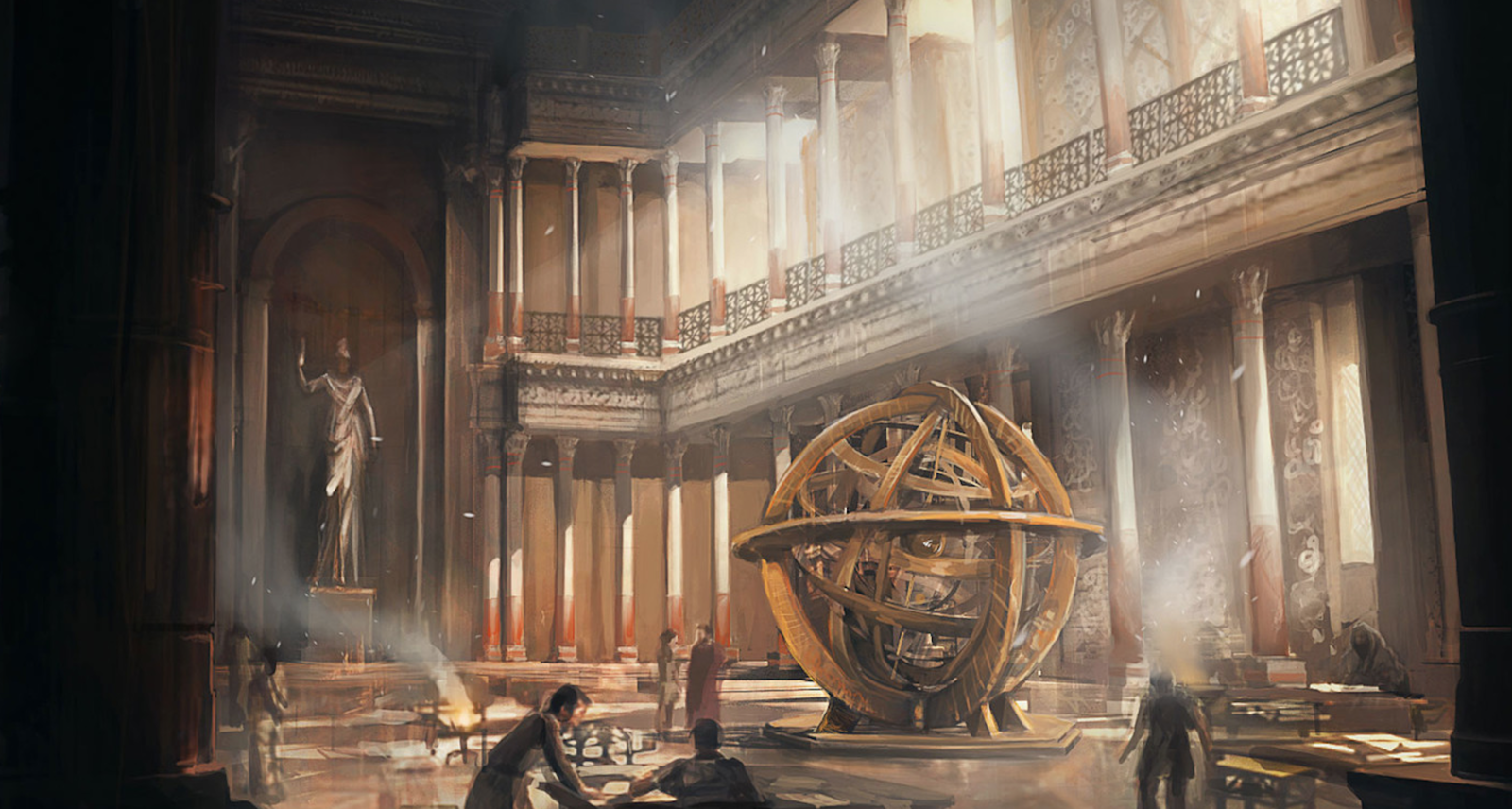
The Great Library of Alexandria, situated in the Egyptian city of Alexandria, remains one of history’s most legendary repositories of knowledge. Established during the reign of Ptolemy II in the 3rd century BCE, the library was envisioned as a universal center for learning. Scholars from across the Mediterranean and beyond traveled to study philosophy, mathematics, astronomy, medicine, and literature. It was more than a library; it was a hub of innovation, a melting pot of ideas, and a symbol of humanity’s relentless pursuit of understanding. The ambition behind its creation was unparalleled, reflecting a desire to preserve all human knowledge in a single place.
Origins and Construction
The library was part of a larger research institution called the Mouseion, dedicated to the Muses, the goddesses of arts and sciences. Ptolemaic rulers commissioned scholars to gather scrolls from every known civilization. Ships docking in Alexandria were meticulously searched for manuscripts; original works were copied, and one copy was sent to the library while the other returned to its owner. This massive collection effort aimed to consolidate wisdom from Greece, Egypt, India, Persia, and Mesopotamia. The library itself was designed with grand halls, reading rooms, lecture spaces, and storage areas to house hundreds of thousands of scrolls, though exact architectural details remain a subject of scholarly reconstruction.
Collections and Scope of Knowledge
The Great Library’s scope was staggering. Scrolls included the works of Homer, Euclid, Archimedes, and countless other luminaries whose original texts are now lost to history. In addition to Greek philosophy and science, the library collected Egyptian papyri, Babylonian astronomical tables, Indian mathematical treatises, and Persian texts. The breadth of subjects included mathematics, physics, astronomy, medicine, geography, poetry, drama, and theology. Some accounts suggest the library may have housed up to 400,000–700,000 scrolls at its peak. It was a place where scholars could study multiple disciplines side by side, fostering interdisciplinary research centuries ahead of its time.
Scholars and Intellectual Life
The library attracted some of the greatest minds of antiquity. Eratosthenes, the Greek mathematician and geographer, calculated the Earth’s circumference with astonishing accuracy while working there. Hipparchus, a pioneering astronomer, developed early models of the solar system and studied celestial mechanics within the library’s walls. Scholars translated texts into Greek, debated theories, and shared knowledge across disciplines. The collaborative environment encouraged experimentation and innovation, creating a thriving intellectual community unparalleled in the ancient world.
Cataloging and Organization
Despite the vast size of the collection, the library was organized meticulously. Callimachus, a librarian and poet, is believed to have created the “Pinakes,” one of the earliest known bibliographic systems, cataloging scrolls by author and subject. This early form of library science allowed scholars to navigate the enormous collection efficiently. The system of organization reflects a sophisticated understanding of information management and highlights the library’s role as not only a repository but a functional research institution.
The Mystery of Its Destruction
Despite its prominence, the Great Library gradually disappeared under mysterious circumstances. Multiple accounts suggest that fires, political unrest, and invasions contributed to its destruction. Julius Caesar’s siege of Alexandria in 48 BCE reportedly led to the burning of part of the city, possibly affecting the library. Later Roman and Byzantine periods, combined with religious and political upheavals, may have destroyed additional sections. The exact timeline and sequence of events remain debated, making the library a symbol of both human achievement and vulnerability.
Lost Knowledge and Legacy
The loss of the Great Library resulted in the permanent disappearance of countless works, from advanced mathematical treatises to historical chronicles and philosophical debates. Many ideas preserved in the scrolls were lost for centuries, slowing the progress of science and thought. Yet, its legacy endures. The library symbolizes humanity’s aspiration to gather, preserve, and expand knowledge, reminding us of both the value of intellectual preservation and the fragility of cultural heritage.
Reconstruction Attempts and Modern Inspiration
Throughout history, the idea of a universal library has inspired modern institutions. The Bibliotheca Alexandrina, inaugurated in 2002 near the ancient site, pays homage to its predecessor. It houses millions of books, museums, research centers, and digital archives. Modern libraries, universities, and online knowledge repositories echo the ambition of Alexandria, showing that the dream of universal access to information continues. This enduring influence highlights the library’s role not just in history, but as an inspiration for generations of scholars.
Cultural Impact and Mythology
The Great Library has fueled myths, legends, and stories for centuries. Ancient accounts describe secret chambers, hidden scrolls, and forbidden knowledge. Writers and artists have depicted it as a mystical place where secrets of the universe were stored. Its aura of mystery, combined with the tragic loss of its collection, elevates it beyond a mere historical site to a cultural and intellectual symbol of wonder, ambition, and the consequences of neglect.
Lessons from Alexandria
The story of the Great Library emphasizes the importance of knowledge preservation, interdisciplinary collaboration, and cultural investment. It teaches that human progress depends not only on creation but also on safeguarding achievements for future generations. In an age of digital information, Alexandria’s legacy reminds us that knowledge, once lost, is difficult, if not impossible, to recover, and that protecting intellectual heritage is a responsibility shared across civilizations.
Conclusion: The Eternal Allure of Lost Wisdom
The Great Library of Alexandria remains an enduring symbol of humanity’s curiosity, ambition, and the quest for understanding. Though its scrolls vanished centuries ago, the ideas it nurtured and the inspiration it provides continue to influence scholars, scientists, and educators worldwide. As we expand, preserve, and share knowledge in the modern era, we honor the spirit of one of history’s greatest intellectual wonders, ensuring that the lessons of Alexandria endure for generations to come.