In the heart of California’s Death Valley lies one of the most perplexing natural phenomena on Earth. Large rocks, some weighing hundreds of kilograms, appear to move across flat, dry lake beds without human or animal assistance. Known as the sailing stones, these rocks leave long tracks in the cracked desert floor, creating a mysterious pattern that has baffled scientists and intrigued visitors for decades. In this post, we explore the science, history, and wonder behind this seemingly impossible natural phenomenon.
The Racetrack Playa: A Desert Stage for Movement
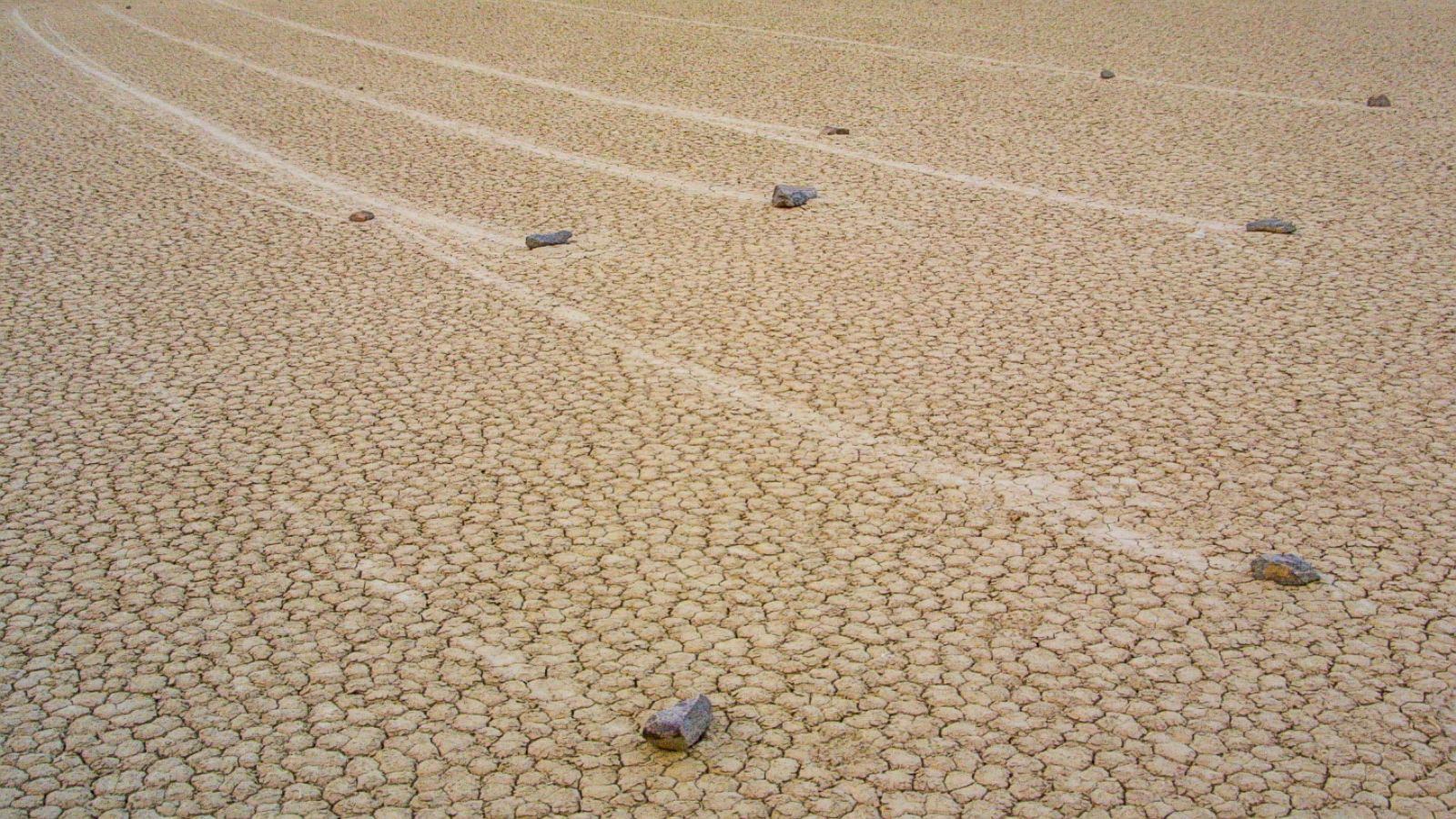
The Racetrack Playa is a dry lake bed approximately four kilometers long and two kilometers wide, located in Death Valley National Park. Its flat, clay surface, surrounded by mountains, creates ideal conditions for observing the sailing stones. The playa’s surface consists of dried mud that forms polygonal patterns when cracks appear during the hot, dry months. These conditions, combined with occasional rains and freezing temperatures, create a natural laboratory for the mysterious movement of rocks.
Early Observations and Theories
Sailing stones were first documented in the early 20th century by geologists and curious visitors. Early observers speculated that strong winds might push the rocks across the playa, while others suggested that the movement could be due to human intervention or underground seismic activity. For decades, the phenomenon remained unexplained, and it became a source of fascination, spawning myths and legends about supernatural forces moving the stones.
The Tracks of Time: Understanding the Trails
The long trails left behind by moving rocks vary in width, length, and shape. Some tracks extend over hundreds of meters, often curving and branching in unexpected ways. The stones themselves display scratches and grooves consistent with friction against the clay surface. These tracks provide valuable clues about the speed, direction, and mechanism of movement, helping researchers analyze the forces at work in this seemingly impossible motion.
Scientific Discovery: Ice Sheets and Wind Collaboration
In recent years, scientists used time-lapse photography and GPS tracking to solve the mystery. The movement occurs when thin sheets of ice form on the playa after winter rains. As the ice begins to melt under the sun, it breaks into floating panels that can gently push the rocks. Even light winds are enough to move the ice and rocks across the wet, slippery clay surface. This combination of ice, water, and wind creates a rare natural mechanism that allows large stones to sail across the desert floor.
Variation in Rock Sizes and Movements
Not all rocks move in the same way. Smaller stones often slide easily with minimal ice assistance, while larger boulders require slightly thicker ice and more sustained wind to move. The speed of movement varies, with some rocks traveling a few meters per minute and others moving more slowly, creating tracks that record subtle shifts in direction. These differences make each sailing stone a unique participant in this natural spectacle.
Environmental Conditions That Enable Sailing
The phenomenon is highly dependent on precise environmental conditions. Winter rains must saturate the playa, temperatures must drop to form ice sheets, and calm winds must occur to gently nudge the ice and rocks. Without this exact combination, the rocks remain stationary for months or even years. The rarity of these conditions adds to the wonder of the sailing stones and explains why the movement is not observed continuously.
Scientific and Cultural Significance
The sailing stones illustrate the intricate interplay between geology, climate, and physics. They demonstrate how subtle natural forces can create seemingly impossible phenomena. Culturally, the stones have inspired awe, folklore, and tourism in Death Valley. Visitors often hike long distances to see the rocks and their tracks, appreciating the mystery and patience required to observe them in motion.
Challenges in Preservation
Despite their remote location, sailing stones are vulnerable to human interference. Rocks can be moved intentionally, tracks can be damaged by foot traffic or vehicles, and the delicate clay surface can be altered by erosion. National Park authorities implement regulations to protect the playa, ensuring that future generations can continue to witness this natural wonder in its pristine state.
Conclusion: Nature’s Patience and Precision
The sailing stones of Death Valley remind us that nature operates on a scale and timescale often beyond human perception. Rocks move imperceptibly, guided by ice, water, and wind, leaving trails that tell stories of rare environmental cooperation. Witnessing or even learning about these moving stones evokes curiosity, wonder, and respect for the subtle forces shaping our world. They are a testament to patience, precision, and the hidden magic that exists in the most extreme environments.