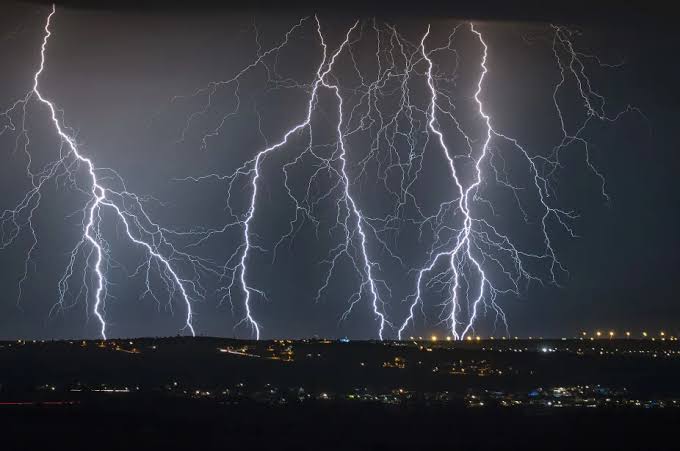
Lightning is one of nature’s most powerful and mysterious forces. A single bolt can heat the air hotter than the surface of the sun, shake buildings with explosive thunder, and illuminate the sky with brilliant flashes. Yet for all its power, lightning follows precise scientific rules. It is a natural electrical discharge created when charges inside clouds separate and build immense energy. Understanding how lightning works takes us into atmospheric physics, electricity, cloud formation, and the deep processes happening within storms. In this authority level explanation, we explore why lightning forms, how it travels, and what makes it one of Earth’s most dramatic natural wonders.
The Birth of a Storm Cloud
Lightning begins inside towering storm clouds called cumulonimbus clouds. These clouds can rise more than ten kilometers into the sky, reaching temperatures far below freezing. Inside them, water droplets, ice crystals, and hail are constantly colliding. Strong updrafts push lighter particles upward, while heavier particles fall. This never ending movement is what creates the conditions needed for lightning. As particles crash into one another at high speeds, electrons are knocked off and charges separate. The constant mixing of air, moisture, and ice is the engine that builds the electrical imbalance responsible for thunderstorms.
Charge Separation Inside Clouds
To understand lightning, we must understand charge separation. Thunderclouds become electrically charged because different particles carry different charges after collision. Larger hailstones and graupel typically become negatively charged and fall toward the middle and lower parts of the cloud. Smaller ice crystals become positively charged and are lifted to the top of the cloud by strong winds. Over time, the cloud becomes like a giant battery. The top holds positive charge. The bottom holds negative charge. The ground underneath the cloud becomes positively charged due to induction. This difference in charge grows stronger until the electric field becomes powerful enough to overcome the insulating resistance of the air. At that moment, lightning becomes possible.
Why Air Breaks Down
Air is normally a great insulator. Electricity cannot easily pass through it. For lightning to form, the electric field inside the storm must become strong enough to ionize the air. Ionization means stripping electrons off air molecules, turning them into charged particles. Once the electric field reaches millions of volts per meter, the air can break down. The once insulating air becomes a conductor, and electricity can rush through it. This sudden breakdown of air is the moment lightning begins. The lightning channel starts forming as the path of least resistance opens through the sky.
The Stepped Leader
The first visible stage of lightning is a dim, branching path called the stepped leader. It moves downward from the cloud in a series of rapid steps, each lasting a fraction of a millisecond. Each step advances about fifty meters at a time. It is not bright enough to be seen by humans, but it is where the lightning channel is created. The stepped leader zigzags unpredictably through the air because it is searching for the easiest path toward the ground. As it approaches the surface, electric fields around tall objects become extremely strong. Trees, buildings, antennas, and even people develop upward streamers. These streamers rise to meet the descending leader. When one connects with the stepped leader, the full lightning channel is completed.
The Return Stroke
When the leader and the streamer meet, the real lightning flash occurs. A massive surge of electric current travels upward from the ground to the cloud. This surge is called the return stroke. It moves at a significant fraction of the speed of light and carries tens of thousands of amperes. The return stroke is the bright flash we see in the sky. It heats the air to temperatures of about thirty thousand degrees Celsius. This superheated air expands explosively, creating the thunder we hear shortly after the flash. Lightning seems to strike downward, but the most powerful part of the discharge actually travels upward as it completes the circuit.
Thunder and Shockwaves
Thunder is not caused by clouds or wind. It is purely the sound of the air exploding. When lightning superheats the air, the sudden increase in temperature causes the air to expand faster than the speed of sound. This creates a shockwave similar to a small sonic boom. As the shockwave travels outward, it slows into rolling sound waves we hear as thunder. The distance between lightning and thunder reveals how far away the strike happened. Every three seconds between the flash and the sound equals roughly one kilometer of distance. Thunder can rumble for long distances because sound waves reflect off clouds and terrain, echoing across the sky.
Different Types of Lightning
Not all lightning is the same. Many forms exist, each shaped by unique atmospheric conditions. Cloud to ground lightning is the most known type and the one that strikes the earth. It is also the most dangerous. Some lightning strikes travel from the ground upward. These are more common on tall buildings like skyscrapers and radio towers. Intra cloud lightning occurs inside the cloud itself and makes up the majority of all lightning flashes. Cloud to cloud lightning jumps between different clouds. Sheet lightning lights up the sky without a visible bolt because the flash is hidden behind clouds. Heat lightning is not a type of lightning at all. It is simply distant lightning whose thunder cannot be heard. Each form of lightning follows the same electrical principles but appears differently depending on where the charge travels.
Why Lightning Strikes the Ground
Lightning does not strike the ground because the ground is electrically special. It strikes because the ground provides a path that completes the electrical circuit of the storm. The tall objects and open fields simply increase the electric field strength at those points, making them more likely locations for a connection to form. This is why lightning rods work. They provide a safe path for the electrical current, guiding it into the ground without damaging structures. The ground itself stores enormous positive charge during storms. This positive charge rises upward through conductive materials until it meets the negative charge rushing downward. When the two charges meet, the lightning bolt is complete.
The Power Inside a Lightning Bolt
A single lightning bolt carries enormous energy. The typical strike carries about five billion joules of energy. This is enough to power a small town for a few seconds. The currents inside a bolt range from ten thousand to two hundred thousand amperes. The voltage can reach hundreds of millions of volts. Temperatures inside the channel are hotter than stars. Despite this power, the bolt lasts only a few milliseconds. The visible flash often flickers because multiple return strokes travel up the same channel. Each stroke rebrightens the bolt until the charge is fully neutralized.
Lightning and the Atmosphere
Lightning is not just dramatic. It plays a vital role in Earth’s atmosphere. It helps maintain the electromagnetic balance between the ground and the sky. Without lightning, the global electrical circuit would collapse. Lightning also produces nitrogen oxides by breaking nitrogen molecules in the air. These nitrogen oxides are important for soil fertility because they eventually fall to the ground and become nitrogen compounds plants can use. Before humans discovered fertilizers, lightning was one of the main natural sources of usable nitrogen in ecosystems. So despite its danger, lightning is an essential part of Earth’s natural cycles.
The Mystery of Ball Lightning
One of the strangest lightning phenomena is ball lightning. It appears as a glowing sphere floating near the ground during storms. It can drift through rooms, pass through windows, or explode suddenly. Scientists have studied ball lightning for centuries, yet its cause remains uncertain. Some theories suggest it is caused by vaporized silicon burning in the air. Others propose it is a plasma phenomenon or a type of electromagnetic knot. Because ball lightning is unpredictable and rare, collecting data is difficult. It remains one of the few lightning mysteries science has not fully solved.
Lightning Safety and Survival
Understanding how lightning works also teaches us how to stay safe. The safest place during a storm is indoors or inside a car with closed windows. Cars are safe because the metal frame directs the lightning around passengers through a protective shell known as a Faraday cage. Standing under trees, on open fields, near water, or holding metal objects greatly increases the risk of being struck. If caught outside, the safest action is to crouch low, minimize contact with the ground, and avoid tall objects. Lightning strikes are rare but extremely dangerous, so respecting storm warnings saves lives.
The Beauty and Power of Lightning
Lightning is one of nature’s most breathtaking displays of energy. It begins with tiny collisions inside clouds, grows into massive charge separations, and ends with explosive flashes visible for miles. It shapes ecosystems, fertilizes soil, balances the atmosphere, and inspires awe. Understanding lightning reveals how powerful nature is and how carefully balanced our planet’s systems are. What begins as a small electrical imbalance inside a storm becomes a spectacular display of energy that reminds us of the hidden forces shaping our world.