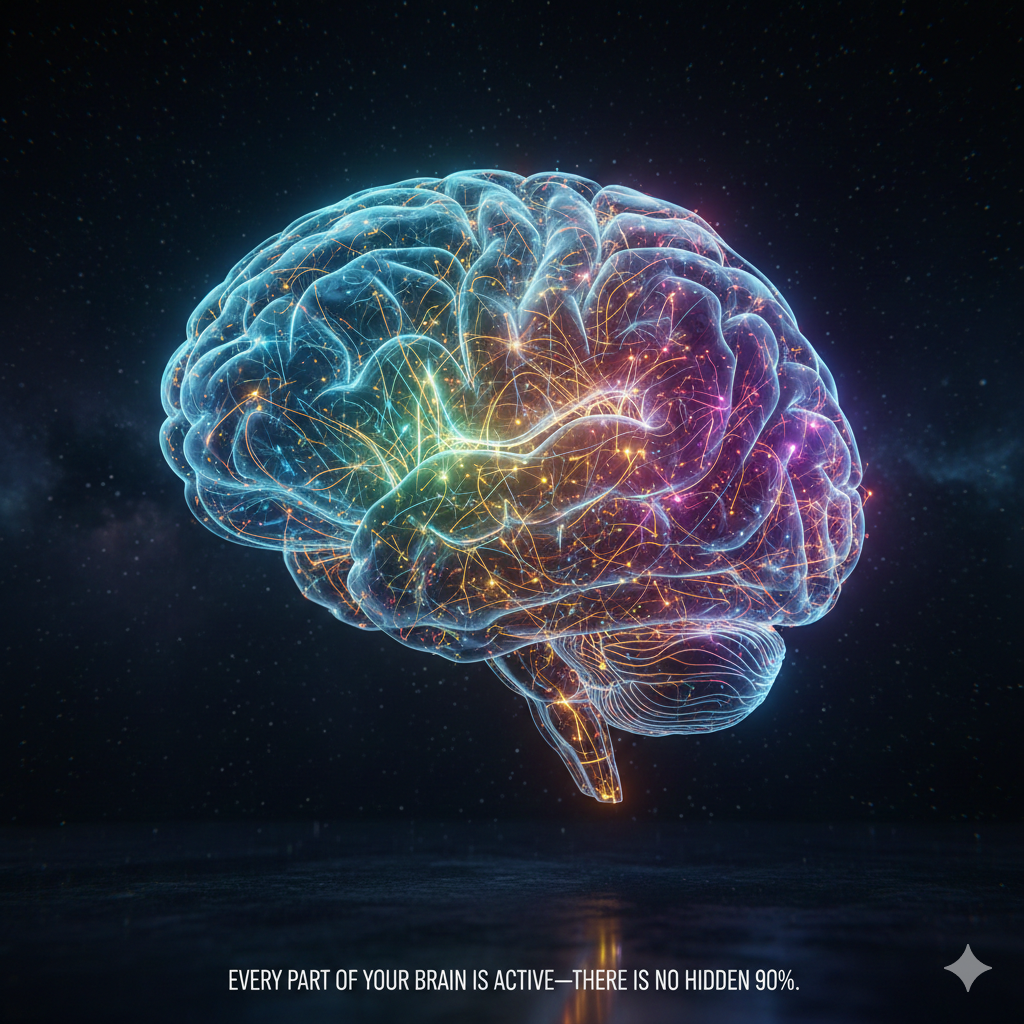
You have probably heard the claim that humans only use ten percent of their brains. It is one of the most persistent myths in popular science, appearing in movies, self-help books, and motivational talks. The idea is simple and appealing: if we are only using a fraction of our brain, there must be hidden potential waiting to be unlocked. But is there any truth behind this claim, or is it simply a myth that has been repeated too many times?
The ten percent myth has been circulating for over a century, and its origins are somewhat unclear. Some historians trace it back to early neuroscience experiments in the late nineteenth and early twentieth centuries. At the time, scientists observed that only a small portion of the brain seemed active during specific mental or physical tasks. Others suggest the myth originated from a misinterpretation of the writings of psychologist William James, who discussed the untapped potential of the human mind, not the brain’s physical usage. Whatever the origin, the statement was eventually twisted into a so-called scientific fact, spreading through popular culture and education.
Contrary to the ten percent claim, modern neuroscience has shown that humans use all parts of the brain. Brain imaging technologies, including MRI and PET scans, allow scientists to observe brain activity in real time. These scans reveal that virtually every region of the brain is active at different times. While it is true that not every neuron fires at once, over the course of a day, humans use nearly every part of their brains for thinking, moving, sensing, regulating bodily functions, and processing emotions.
For example, simple activities like walking involve coordination between multiple brain regions. Sensory information from the eyes and ears is processed, motor signals are sent to muscles, and the cerebellum helps maintain balance. Even activities that seem purely cognitive, like solving a math problem or reading a book, engage multiple areas of the brain simultaneously. No part of the brain is truly inactive; each region has a specific function that contributes to overall cognition and bodily control.
Think about your daily life. When you wake up, your brain immediately starts working to regulate your breathing, heartbeat, and body temperature. As you move through your morning routine, you are reading, recalling memories, making decisions, and reacting to your environment. Each of these tasks engages multiple regions of your brain at once. Even mundane activities like pouring coffee, brushing your teeth, or checking your phone require coordination between sensory input, motor function, and memory recall. The brain is never truly idle, and this constant activity shows that the ten percent idea is simply false.
The ten percent myth continues to be popular because it is an appealing idea. It suggests that there is a vast reservoir of untapped mental power that, if unlocked, could give people superhuman abilities. This notion is often exploited by motivational speakers, self-help books, and fictional works in movies and television. People like the idea of hidden potential because it offers hope and the promise of extraordinary capabilities. However, it is important to understand that this hope is based on a false premise.
Believing the myth can also lead to misconceptions about brain training and cognitive improvement. Some people may spend time and money on dubious techniques claiming to unlock unused parts of the brain. The truth is that improving cognitive function is not about activating dormant neurons; it involves practice, learning, and maintaining overall brain health through proper nutrition, sleep, exercise, and mental challenges.
The human brain is incredibly complex, with around 86 billion neurons and trillions of connections between them. These neurons communicate constantly through electrical and chemical signals, forming networks that are highly specialized. Different tasks require different combinations of neural activity. For instance, language processing involves regions in the left hemisphere, memory formation engages the hippocampus, and emotional responses are processed in the amygdala. Even while resting or sleeping, the brain remains active, maintaining essential bodily functions, consolidating memories, and processing experiences from the day.
Because the brain is so complex, it is impossible to reduce its activity to a simple percentage. The notion that ninety percent of the brain is unused does not reflect the reality of how neurons function. Every part of the brain has a role, even if some roles are less obvious than others.
The ten percent myth also stems from a misunderstanding of what potential means. People interpret potential as unused space, as if there is a hidden superpower lying dormant. In reality, potential is about development and efficiency. You can improve your memory, learn new skills, and enhance problem-solving abilities, but this is done by strengthening existing neural pathways, not activating unused parts of the brain. The brain is already highly optimized to perform the tasks required for survival and everyday life, and any improvement comes from practice and adaptation.
The idea that humans only use ten percent of their brains is a myth. Modern science demonstrates that we use nearly all parts of our brains over time, and no hidden areas are waiting to be unlocked. While the concept is appealing, it misrepresents the incredible complexity and capability of the human brain. Your brain is already a powerful organ, and understanding how it works can help you appreciate the extraordinary abilities you already possess. Instead of searching for unused brain power, focus on learning, practicing new skills, and maintaining brain health. That is where true potential lies.
Next time someone repeats the ten percent claim, you will know it is a myth. Your brain is doing far more than ten percent, and that is remarkable enough to inspire awe. Every thought, every action, and every emotion engages complex neural networks that make you who you are. The brain is not a dormant organ; it is an active, dynamic system that works continuously to support your life and experiences.