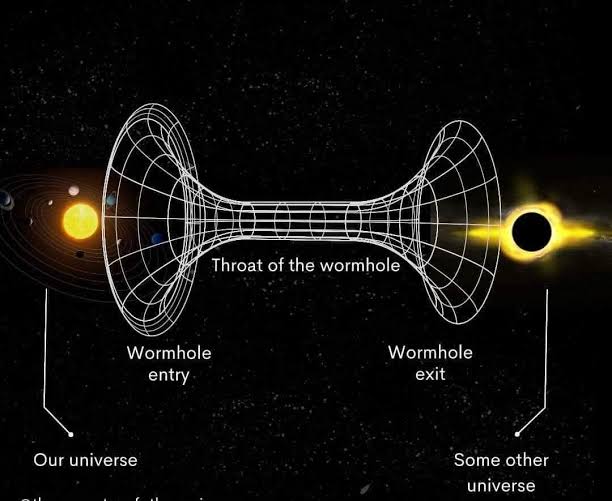
Wormholes are among the most intriguing and mysterious possibilities in the universe. But what are they really? Could they exist outside of science fiction, or are they purely theoretical? Scientists define a wormhole as a tunnel-like structure connecting two separate points in space and time. Imagine a shortcut through the very fabric of the universe, where two distant locations are linked by a bridge that could potentially bend reality itself. If wormholes exist, could we travel vast distances instantly? Could they allow time travel? Could they even let us glimpse parallel universes? Understanding wormholes requires exploring both the limits of physics and the imagination.
How could wormholes form in the first place?
The origin of wormholes remains one of the great cosmic mysteries. Some theories suggest that natural wormholes could form from the extreme warping of spacetime caused by massive objects like black holes or neutron stars. Others speculate that wormholes might arise from quantum fluctuations in the early universe or from the influence of exotic matter. Could the Big Bang itself have left tiny wormholes scattered across the cosmos? Scientists are not yet certain, but studying the equations of general relativity and quantum mechanics provides potential clues. Could these cosmic tunnels have existed since the beginning of time, waiting to be discovered?
What makes wormholes so unusual compared to ordinary space?
Unlike the familiar, flat space we experience every day, a wormhole is a tunnel with two openings, called mouths, connected by a throat. Could the laws of physics allow this throat to remain stable long enough for anything to pass through? Ordinary matter would collapse a wormhole almost immediately, which is why scientists theorize that “exotic matter” with negative energy density may be necessary to keep it open. What properties must this exotic matter have to counteract gravity and stabilize spacetime? Could it even exist in sufficient quantities? These questions highlight how wormholes push the boundaries of known physics.
Could wormholes allow travel faster than light?
One of the most exciting possibilities of wormholes is that they could create shortcuts through space. Could a spacecraft enter one mouth and instantly emerge light-years away? While nothing can travel faster than light in normal space, could a wormhole bypass that limitation entirely by bending spacetime? The speed of travel would depend on the wormhole’s stability and size. Could this someday make interstellar travel feasible for humans, turning galaxies into reachable destinations within a human lifetime? Theoretical models suggest it is possible, but practical implementation remains far beyond current technology.
Could wormholes allow time travel or access alternate realities?
If wormholes connect not just different points in space but also different points in time, could someone travel into the past or the future? Theoretically, if one mouth of a wormhole moves at near light speed while the other remains stationary, time dilation could create a difference in temporal position between the two ends. Could someone enter the wormhole and emerge centuries earlier or later? Some theorists even propose that wormholes could act as gateways to parallel universes, where each universe branches from a different outcome of events. What paradoxes might arise, and could unknown physical laws prevent contradictions, like the famous grandfather paradox?
How would we detect a wormhole if one exists?
Even if wormholes exist, spotting them is extraordinarily difficult. Could their presence be revealed through gravitational lensing, where light bends in unusual ways around massive objects? Might we detect high-energy cosmic rays or strange fluctuations in space-time that indicate the influence of a hidden wormhole? Could precise timing of pulsars or gravitational wave detectors provide clues? Scientists continue to devise methods for finding indirect evidence, but no confirmed detection has occurred so far. Could wormholes be hiding in plain sight, invisible to current instruments?
What dangers might exist inside a wormhole?
Even if a wormhole could be traversable, could any object survive the journey? Extreme tidal forces might stretch or compress anything passing through, turning it into a long, thin strand or crushing it entirely. Radiation levels could be deadly. Could the exotic matter that stabilizes the wormhole create unknown hazards? Theoretical models suggest that navigating a wormhole safely would require shielding and precise control. Could this explain why no natural wormhole travel has been observed, leaving them confined to equations and imagination?
Could wormholes revolutionize our understanding of the universe?
If wormholes exist, could they redefine our concepts of space, time, and reality itself? They challenge our assumptions about distance, causality, and the flow of time. Could they provide a framework for unifying general relativity and quantum mechanics, the two pillars of modern physics that have resisted full reconciliation? Could understanding wormholes open doors to hidden dimensions, alternate timelines, or unknown physical laws? Studying them stretches the limits of human knowledge and inspires both scientists and storytellers to imagine worlds beyond the visible universe.
Are wormholes forever beyond our reach?
Despite decades of theoretical research, practical wormhole travel remains speculative. Could we ever create a stable wormhole in a laboratory? Could future discoveries in exotic matter, quantum gravity, or advanced propulsion make them traversable? For now, wormholes remain one of the greatest cosmic questions, a tantalizing mystery at the intersection of physics, mathematics, and imagination. Could the universe itself be filled with hidden shortcuts, waiting for a civilization capable of unlocking them?