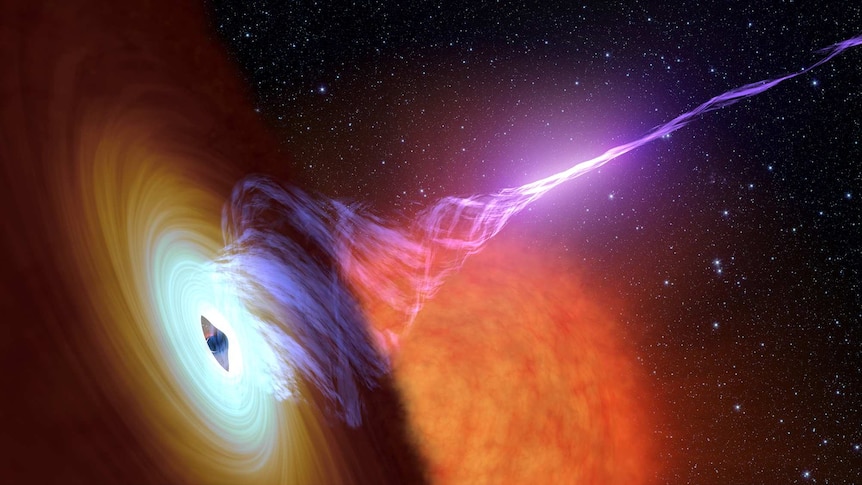
Black holes are regions in space where gravity is so intense that nothing, not even light, can escape. But what exactly happens inside one? How do these objects form from collapsing massive stars, and could they hold secrets beyond ordinary matter and energy? Scientists describe black holes using the equations of general relativity, yet the true nature of their cores—the singularities—remains unknown. Could black holes serve as cosmic gateways to alternate universes or dimensions?
How might black holes connect to other universes?
Theoretical physics suggests that some black holes could be “wormholes,” bridges connecting different regions of space and time. Could the singularity at a black hole’s center be a passage to another universe? While matter falling into a black hole appears to vanish, could it emerge elsewhere, in a different cosmos? Could these connections explain some of the universe’s most puzzling mysteries, such as dark matter, dark energy, or unexpected cosmic structures?
What role does Hawking radiation play in understanding black holes?
Hawking radiation, a quantum effect predicted by Stephen Hawking, suggests that black holes slowly emit energy and lose mass over time. Could this radiation provide clues about the interior of black holes and their potential as cosmic gateways? Could observing or measuring Hawking radiation reveal information about other universes or the fundamental nature of spacetime? Scientists continue to explore how quantum mechanics and general relativity interact in these extreme environments.
Could black holes preserve information instead of destroying it?
The “information paradox” questions whether information about matter falling into a black hole is lost forever. Could black holes encode this information in ways we do not yet understand? Some theories suggest that the information might be preserved on the event horizon or escape through hypothetical wormholes. Could this mean black holes are not merely cosmic traps but essential parts of a larger multiverse network? Understanding this could reshape physics and our conception of reality.
How do supermassive black holes influence galaxies?
Supermassive black holes, millions to billions of times more massive than our Sun, sit at the centers of most galaxies. How do they affect the formation and evolution of stars, planetary systems, and galaxies themselves? Could their immense gravity influence cosmic structures in ways that hint at deeper universal connections? Studying these massive black holes may provide indirect clues about the behavior of black holes as potential gateways.
Could black holes explain cosmic phenomena we cannot otherwise understand?
Some scientists speculate that unexplained cosmic signals, high-energy particles, or gravitational waves might originate from black holes interacting with other universes or hidden dimensions. Could black holes act as natural laboratories for testing theories of quantum gravity, string theory, or multiverse models? Could studying black holes help answer fundamental questions about the universe that ordinary observations cannot?
What are the dangers and limitations of exploring black holes?
Even if black holes could theoretically connect to other universes, could any object survive entering one? Extreme gravitational tides, immense radiation, and the unknown properties of singularities would make survival nearly impossible. Could advanced technology or theoretical models ever allow safe exploration? For now, black holes remain a tantalizing mix of imagination and extreme physics, where curiosity meets impossibility.
Could black holes reshape our understanding of space, time, and reality?
If black holes are more than cosmic traps, could they provide insights into the deepest laws of the universe? Might they reveal hidden dimensions, alternate timelines, or connections between parallel universes? Could studying black holes help unify general relativity with quantum mechanics, solving one of science’s greatest puzzles? The implications of black holes extend far beyond gravity and light—they touch the very nature of existence itself.
Why are black holes considered the ultimate cosmic wonders?
Black holes combine mystery, danger, and the unknown into a single cosmic phenomenon. Could they represent gateways, laboratories, and keys to the deepest truths of the universe? Could understanding black holes transform physics, astronomy, and our imagination? They remain one of the most profound, mysterious, and awe-inspiring aspects of the cosmos, challenging humanity to look beyond what is visible and comprehend what might lie beyond.