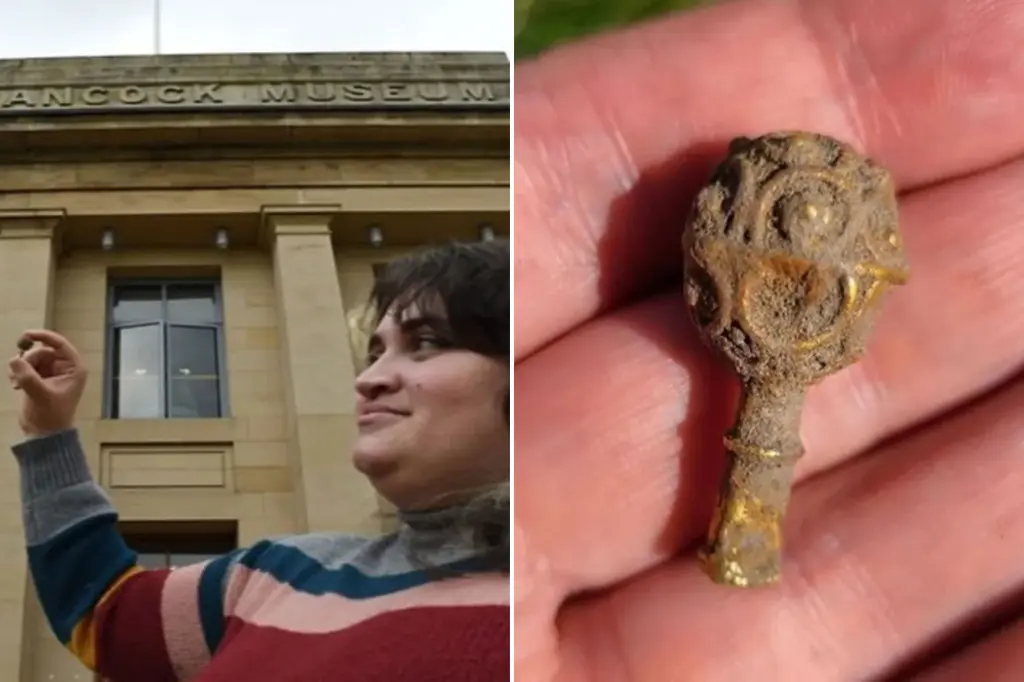
There are moments in life when a single discovery changes everything. For Yara Souza, a young archaeology student from Florida, that moment happened only one hour and thirty minutes into the very first excavation of her life. She was new to fieldwork. She had never handled an actual historical dig site before. She was simply excited to learn. But on that same first day, she uncovered a rare ninth-century gold artifact that stunned her professors, shocked seasoned archaeologists, and quickly became one of the most fascinating stories in the world of archaeology.
This story feels almost unbelievable. A beginner. A first day. A rare treasure made of gold with deep cultural and historical meaning. Finds like this usually come after years of experience or entire teams working for months. Yet fate chose a young student on her first attempt. That is what makes this discovery so powerful and so captivating.
Yara joined the excavation team at Newcastle University with excitement and curiosity. The site she worked on was located along Dere Street, an ancient Roman road known for its deep ties to Roman activity in northern England. The road served as a major route for soldiers, traders, and travellers during the Roman era. Archaeologists study these sites carefully, hoping to uncover objects lost across thousands of years.
Yara was not expecting to be the one who found anything meaningful. Many archaeology students spend days digging without finding even a pottery fragment. Some professionals spend their entire career without discovering anything rare. Yara was simply there to learn the basics. But fate had another plan.
About ninety minutes into her shift, Yara was gently removing layers of soil when her tool scraped against something solid. At first, she assumed it was a stone. But then she noticed something unusual. A faint warm shine was peeking through the dirt. Not the shine of metal scrap or bottle caps. Something richer. Something golden.
Her heart started beating fast as she brushed the surrounding dirt away. The more soil she removed, the clearer the object became. Beautiful. Carefully crafted. Heavy. And definitely gold. Her hands trembled as she held it up. She knew she had found something special, but she did not yet understand just how special.
When her supervising archaeologist approached, he froze the moment he saw it. He immediately knew this was no ordinary object. Gold artifacts from that period are extremely rare. Most do not survive the harsh conditions of centuries underground. And when they do, they are typically discovered at major burial sites or carefully preserved ritual grounds, not during a routine student excavation. The team quickly placed the artifact into a protective container and informed senior experts. What followed was a detailed examination and a wave of excitement that spread through the entire department.
After cleaning and analysing the artifact, experts identified it as a ninth-century gold decorative object. The craftsmanship was exceptional. It had a distinctive finial-like design, the kind seen in ceremonial or high-status items from early medieval England. It was the kind of gold piece that may have belonged to a noble individual, a ritual leader, or a wealthy landowner.
The fact that it was buried near Dere Street added another layer of mystery. Was it lost during travel? Was it part of a ritual offering? Was it stolen and dropped in panic? No one knows yet, but the place and period suggest a strong historical connection.
There are many reasons why people cannot stop talking about this discovery.
First, the sheer luck of it. A first-time student making a find that even experts dream of is almost unheard of.
Second, the object itself. Gold artifacts from the ninth century are rare, and when they appear, they almost always hold cultural or symbolic value.
Third, the mystery. No one knows exactly how the artifact ended up buried where Yara found it. Every possibility opens the door to a different historical storyline, and that is what keeps readers hooked.
After the story spread, many young archaeology students said they felt encouraged by it. Instead of being intimidated by the long history of the field, they felt excited. Yara’s discovery proved that sometimes the most important finds fall into the hands of those who least expect them. It also reminded the world that archaeology is not only about experience, it is also about patience, curiosity, and being at the right place at the right time.
The gold piece is currently stored under controlled conditions and will undergo further analysis. Researchers hope to learn more about its origin, its purpose, and the people who created it. There is also discussion about eventually displaying it in a museum where the public can view it. And yes, Yara’s name will forever be associated with the find. Her first dig may have written her into archaeological history.
What started as a simple student exercise turned into a moment of wonder that amazed experts and captivated audiences. A young woman with little field experience uncovered a treasure that had been hidden for more than one thousand years. And even though the artifact is small in size, its impact is huge.
Stories like this remind us that the world is full of hidden wonders waiting to be found. And sometimes, the person who discovers them is not a master or a veteran, but a beginner with a tool, a bit of patience, and a spark of curiosity.